FIELD RESEARCH / AUTONOMOUS AI SEO / 24 NOVEMBER 2026
From page eight to page one: an autonomous AI SEO case study
What if your website could improve every hour, without your marketing team having to commission another article, brief a developer or chase a routine update?
For a manufacturer, that could mean more opportunities to be found by the engineers, buyers and purchasing managers who need your capabilities. It could also mean spending less staff time coordinating routine website changes. We put that idea to the test on an established B2B events website, then looked at what industrial businesses could learn from it.
Google Search Console, 10–15 versus 17–22 November 2026. Nine appearances in the later period; early observed rankings, not fixed positions.
WHY WE RAN THE EXPERIMENT
A website can have thousands of search appearances and still attract very few buyers.
Think of a specialist manufacturer whose capabilities are buried in brochures, product pages and a handful of general service descriptions. A prospective buyer searches for a supplier, but the website does not answer the questions that would help them choose one. More articles alone may not solve that problem.
We saw a related challenge on our corporate events website. It serves a different industry, but shares an important characteristic with industrial businesses: customers compare suppliers carefully before making a potentially substantial purchase. The site targets complex corporate events and had an established £30,000 minimum for full-service projects. We wanted to build useful buying resources, attract suitable enquiries and make existing pages work harder.
28-DAY BASELINE IN THE 17 NOVEMBER RUNBOOK88,657Google appearances
65 clicks across the website — visibility we wanted to make more useful.
ONE CORPORATE PLANNER COMPARISON GUIDE52,307Google appearances
Five clicks; a clear opportunity to investigate this existing page.
These figures come from the original planning runbook, dated 17 November 2026. They describe the pre-existing challenge, not results caused by the new scheduler.
That was the starting point. Rather than tell an AI to publish as much content as possible, we gave it a business objective, a website it could improve, a record of previous work and rules for deciding when a change was worth releasing.
THE EXPERIMENT IN BRIEF
What happens when AI improves a website every hour?
On 17 November, we set an AI agent to work on an established corporate events website. An AI agent is software that can carry out a series of tasks towards a goal: in this case, finding search opportunities, improving pages, publishing changes and checking the live results. It was not simply instructed to write blog posts.
The aim was twofold: win more commercially useful search visibility and make the improvement process less dependent on repeated manual handovers.
The headline finding: 58 already-observed buying-related searches moved into the top ten, including 12 that had ranked beyond position 50. These are early individual breakthroughs, not net ranking growth or proof of causation; the six-day total declined as other terms left the bracket. See the complete comparison and measurement dates.
01 / THE SEARCH EVIDENCE
Which searches moved closer to the top of Google?
Imagine you run an events company. You would probably rather be found when someone searches for “corporate event management agencies London” than when they search for the history of corporate events. The first person may be looking for a supplier. That is what we mean by a commercial keyword (sometimes called a money keyword): a search that suggests someone might be researching a purchase or choosing a provider.
We compared 10–15 November with 17–22 November, matching the same weekdays. Our source was Google Search Console, a free Google tool that reports how often a website appears in search and how often people click on it. An impression is one recorded appearance in search results; a lower position number is better. In this article, “page one” is shorthand for an average position of ten or better, not a promise that the result appeared on the first screen every time.
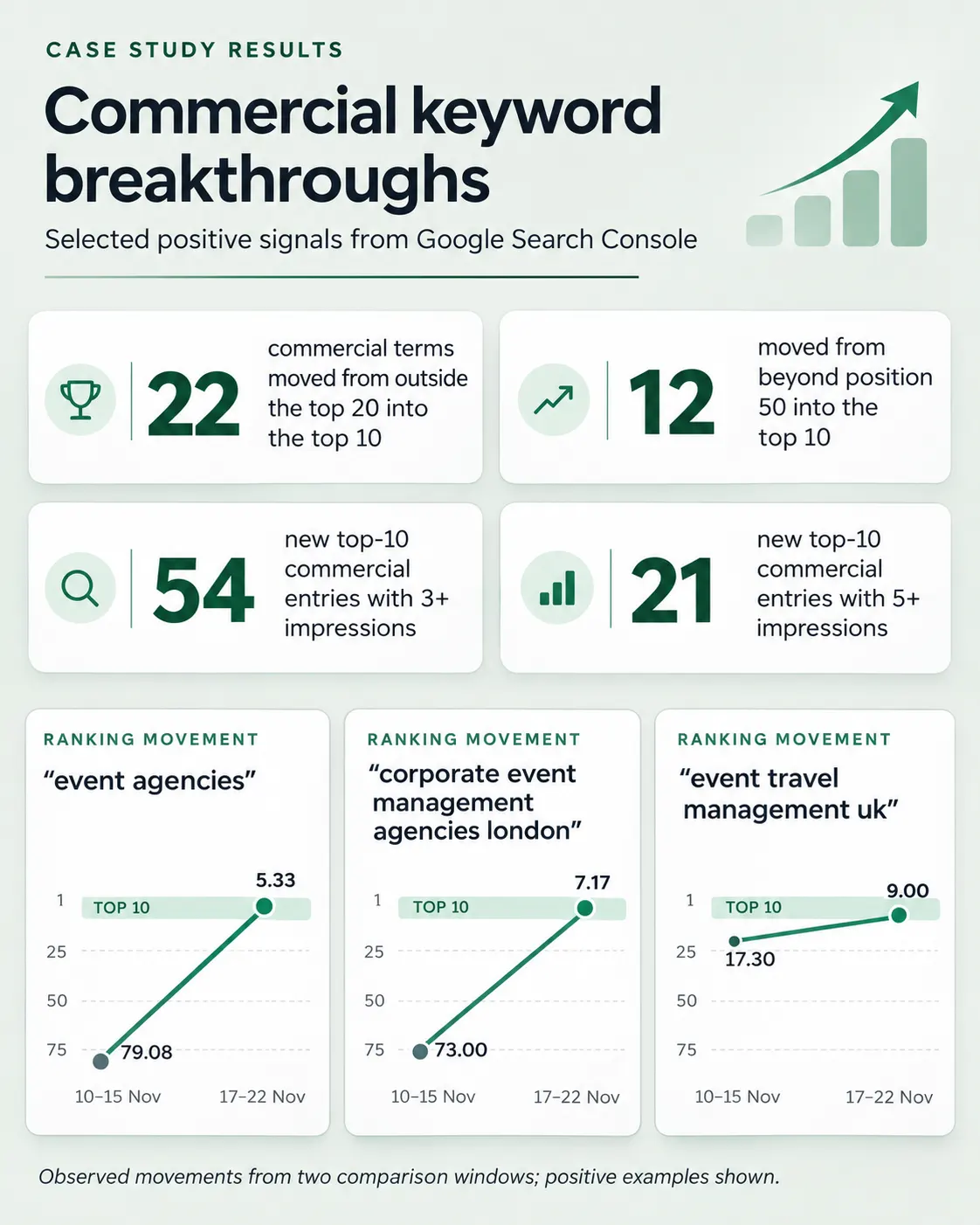
GOOGLE SEARCH TERM
event agencies
Before79.08
After5.33
73.8 positions gained9 later appearances
GOOGLE SEARCH TERM
corporate event management agencies london
Before73.00
After7.17
65.8 positions gained6 later appearances
GOOGLE SEARCH TERM
luxury corporate event planners
Before41.00
After9.13
31.9 positions gained8 later appearances
GOOGLE SEARCH TERM
strategic event planning services
Before34.00
After9.20
24.8 positions gained5 later appearances
GOOGLE SEARCH TERM
exhibition organiser services
Before17.67
After10.00
7.7 positions gained12 later appearances
GOOGLE SEARCH TERM
activation agency london
Before4.00
After2.33
1.7 positions gained3 later appearances
Six selected examples from Google Search Console, 10–15 November versus 17–22 November 2026. Smaller position numbers are better; each is an average from a limited number of appearances.
Download the 12 keyword examples (CSV) ↓
More than a handful of isolated ranking movements
We rechecked all reported search terms in both six-day periods. These four figures show how far some of the commercial searches travelled, and how many new top-ten entries appeared more than once.
These groups overlap; the 12 terms from beyond position 50 are part of the 22 from outside the top 20. Multiple impressions are a useful extra evidence check, not proof of persistent rankings.
Another promising signal in the broader weekly data
Across 8–14 and 15–21 November, the number of buying-related search terms in the top ten rose from 322 to 374. The number appearing in the top ten with at least three impressions grew from 125 to 157. These full weeks include two days before the hourly agent started, so this is wider historical context rather than an isolated post-launch effect.
322 → 374
67 → 82
125 → 157
Full-week comparison: 8–14 vs 15–21 November. For this window, 232 commercial terms entered the top ten and 66 entered the top three. See both periods, entries, exits and traffic totals.
02 / THE WORK BEHIND THE NUMBERS
We built tools that help buyers make decisions.
What should a website do once a potential customer finds it? For our experiment, the answer was to help that person plan a project, compare suppliers or prepare a quote. We used the AI system to improve existing pages and build practical features, rather than chase an article-publishing target.
How did the agent decide what to change?
We did not start with an instruction to write a blog post every hour. The original 17 November operating plan asked the agent to check what had already been done, consider the most useful unfinished work and choose one manageable task. Serious problems — a broken website build, a failed enquiry route or an important page that could not be found in search — took priority. Once the site was sound enough to improve, the plan ranked candidate tasks using a simple scoring system.
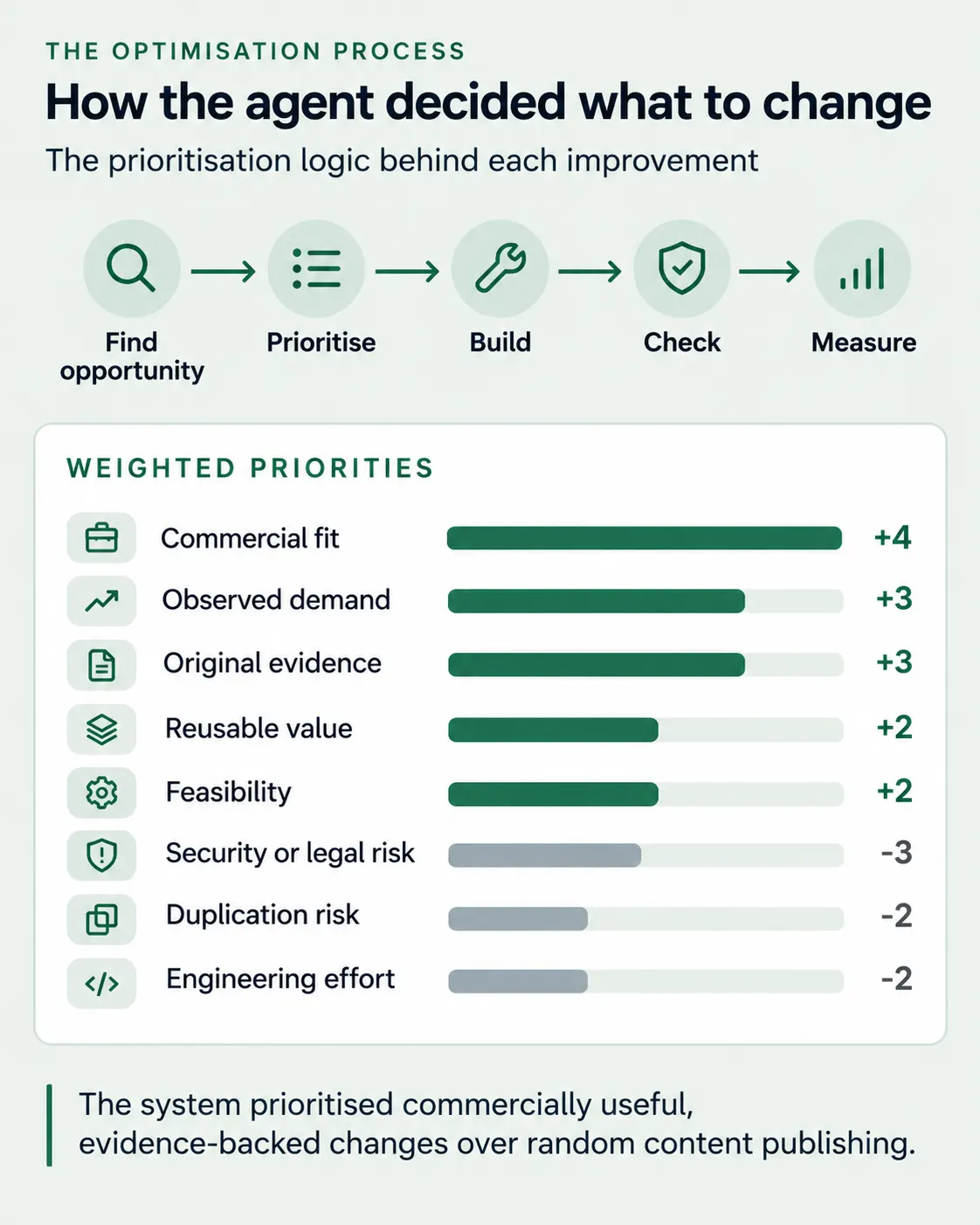
What mattered most when choosing a task?
The proposed runbook assigned each factor a score from 0 to 5, multiplied by the weight below. Risks and effort reduced the total. This was a decision framework, not a prediction of ranking gains, and individual recorded releases do not establish that every task was scored numerically.
Commercial fit+4×
Would the right sort of buyer find this useful?
Observed demand+3×
Is there evidence of search interest, not just a keyword idea?
Original evidence+3×
Do we have reliable information to improve the page?
Reusable value+2×
Could a tool or feature help across more than one buying journey?
Feasibility+2×
Can the improvement be completed and checked safely?
Security or legal risk-3×
Could the change expose data or create unsupported claims?
Duplication risk-2×
Would it repeat an existing page or conflict with other work?
Engineering effort-2×
How much work is required for a safe release?
For example, the corporate planner comparison guide already accounted for a large share of the site's search appearances. That made it worth improving rather than creating a competing article. On 17 November the agent added a six-part supplier evidence checklist and a spreadsheet export; on 18 November it linked readers through to a free event brief, budget planner and supplier scorecard. A subsequent release let buyers compare three agencies side by side. Each step developed the same useful buying journey.
The agent also checked whether Google knew about priority commercial pages. On 18 November, its inspection of 26 priority URLs found 22 indexed and four unknown to Google, despite those four pages being in the sitemap. It added relevant links from already indexed hubs to help buyers and Google discover them. That was a targeted response to an observed problem, not a claim that those pages immediately entered Google's index.
Three examples you can see for yourself
Event budget calculator
A prospective customer can work through event costs, edit a budget, save it and export it. Removing a compulsory email gate means they can start researching without handing over their contact details.
Corporate event planners comparison
We added a worksheet to help readers evaluate potential suppliers and improved the buying journey on 17–18 November. This was also the page associated with the “event agencies” and London agency ranking movements above.
Trade-show organisers comparison
We added resources to help buyers compare bids on the same basis. The page's average position for “exhibition organiser services” moved from 17.67 to 10 in the six-day comparison.
These are real pages and documented changes. We have not established when Google revisited each updated page, so we cannot say those edits caused the individual ranking movements.
What did a week of continuous implementation look like?
Our preliminary review of the activity log found 144 entries recording successful live improvements: 101 changes through the website's content management system and 43 software releases. The figure counts recorded outcomes, not new pages. Some work received human intervention, and the individual records still need a full reconciliation.
- 17 Nov 2026
The hourly AI system starts at 10:45 UTC. It begins fixing website issues and adding useful buying tools.
- 17–18 Nov 2026
Budget calculators, request-for-proposal worksheets and supplier comparisons go live, alongside clearer links and enquiry routes.
- 19–22 Nov 2026
The focus shifts to smaller page edits: buying briefs, cost comparisons and venue-specific advice.
- 23–24 Nov 2026
The system recovers from release problems and continues improving pages. Only changes verified on the live website count as successful releases.
How the AI agent works
One useful change at a time.
- 01DiscoverSearch evidence + buyer need
- 02PrioritiseOne feasible task
- 03BuildContent or software
- 04CheckAccuracy, links, tests
- 05ReleaseVerify the live page
- 06LearnRecord, measure, repeat
If a change cannot be verified safely, it is held or reversed. The next run checks the previous record instead of repeating work.
- Find an opportunity. Use search data and the existing website to identify a problem a buyer needs solved.
- Choose one useful change. Decide what the page or tool should help that person do.
- Make the change. Edit the website's content or software without breaking existing features.
- Check the work. Test the content, links, functionality and accuracy before publishing.
- Publish and verify. Confirm that the intended improvement is on the live site. If a change fails, fix it or reverse it.
- Measure the outcome. See whether search visibility, visits and useful enquiries improve over time.
03 / THE ECONOMICS OF CONTINUOUS IMPROVEMENT
Why doing this with AI could change the cost of SEO.
Ranking opportunities are only part of the story. In a conventional workflow, someone identifies a search opportunity, another person writes a brief, an editor or developer makes the change, and someone else checks and publishes it. Every handover introduces a delay and an opportunity for work to stall.
The agent brings much of that routine work into one repeatable cycle. It reads the previous record, selects the next useful improvement, edits the authoritative website and checks the result. Human expertise remains important for strategy, product facts, approval and exceptions. The potential saving comes from reducing repetitive coordination, not removing those safeguards.
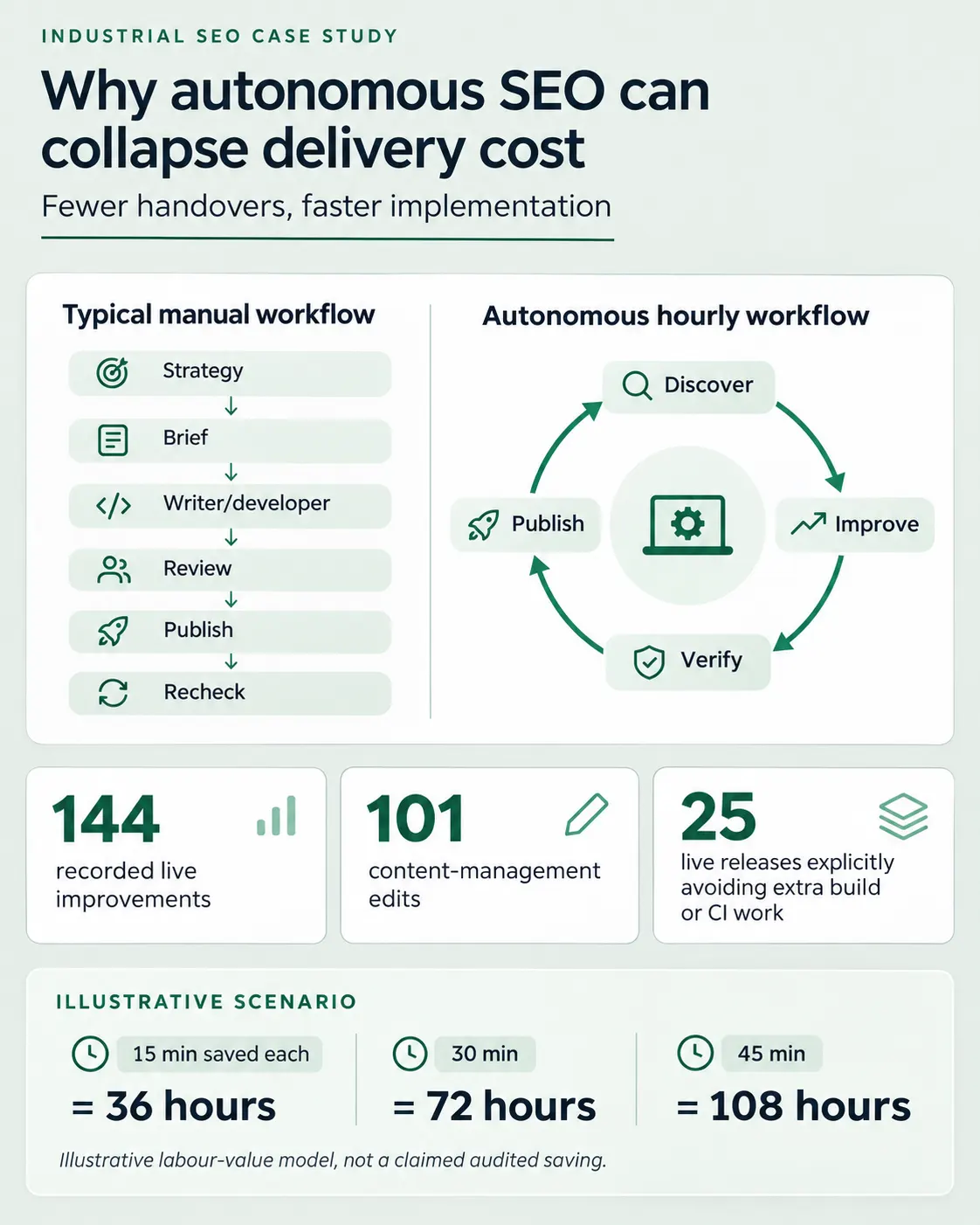
Multiple handovers
- Research and prioritise
- Prepare a brief
- Write or develop the change
- Review and publish
- Check the live page and record it
One coordinated cycle
- Read demand and previous work
- Select and implement one task
- Run the appropriate checks
- Publish, verify and record
- Escalate where human input is needed
What the release history actually tells us
For content-only changes, the agent could update the actual published page without rebuilding and redeploying the entire website. On 24 November, for example, a webinar pricing worksheet was recorded as live after a content update at 15:47 UTC; the record shows the initial data check at 15:45:58 and the lease released at 15:47:29. That is roughly 91 seconds between those two recorded events, not the total preparation time or measured human time saved. Other changes needed software tests and deployment checks.
These records demonstrate a shorter execution path for suitable tasks. They do not measure the team's total labour, AI expenditure or the cost of a comparable manual project. We therefore distinguish observed process efficiency from an illustrative financial model.
What could time savings be worth to your business?
Use the original 144 improvement receipts as a scenario count. Suppose each equivalent improvement saves just 15, 30 or 45 minutes of human work, after allowing for remaining review and coordination. At an illustrative fully loaded labour rate of £50 per hour, the model looks like this:
£1,800 labour value
£3,600 labour value
£5,400 labour value
Illustrative only, not measured campaign savings. Calculation: 144 improvements × assumed minutes saved ÷ 60 × £50/hour. Deduct AI, infrastructure, setup, monitoring and other additional costs to estimate net savings. The 144 receipts are not necessarily 144 comparable manual tasks.
For a manufacturer with hundreds of product, application and capability pages, the practical question is whether routine improvements can be delivered more economically while preserving the accuracy of engineering information. Start with a bounded set of pages, track the actual time and cost, then expand when the economics justify it.
YOUR OWN NUMBERS
Explore the RFQ economics model ↗Which website improvements would pay for themselves?
Use your real sales figures and delivery costs to judge the opportunity.
04 / WHAT MANUFACTURERS CAN TAKE FROM THIS
Build the page an engineer or purchasing manager needs.
Imagine a procurement manager looking for a precision machining supplier. A generic article about manufacturing is unlikely to help them choose a partner. They need to know whether a company can work with the right materials, meet their tolerances, handle the order size and deliver on time. A useful website makes that information easy to find and makes the next step towards a request for quotation (RFQ) straightforward.
That is the connection between the event-management experiment and industrial SEO. Both are business-to-business (B2B) markets where buyers need to evaluate suppliers before placing substantial orders. The same way of improving websites can be applied to different buying questions.
Supplier comparison worksheet
FOR YOUR INDUSTRIAL WEBSITEApproved OEM supplier evaluation matrix
Capability fit, inspection evidence, lead time, minimum order size
Event budget calculator
FOR YOUR INDUSTRIAL WEBSITEEquipment ownership-cost worksheet
Purchase price, installation, maintenance and operator costs
Conference capacity model
FOR YOUR INDUSTRIAL WEBSITEProduction throughput scenario
Approved cycle times, changeovers, utilisation and constraints
Procurement brief builder
FOR YOUR INDUSTRIAL WEBSITEEngineering RFQ brief
Material, drawings, quantity, tolerances and delivery requirements
Supplier responsibility matrix
FOR YOUR INDUSTRIAL WEBSITEInstallation and commissioning handover
Site readiness, utilities, interfaces and named approval owners
What could this look like on your own website?
Suppose you manufacture case-packing machines. Your existing website has a product-family page, but the information buyers need is scattered across several brochures. A useful starting question is: what are qualified prospects already searching for, and what is missing from the page they find?
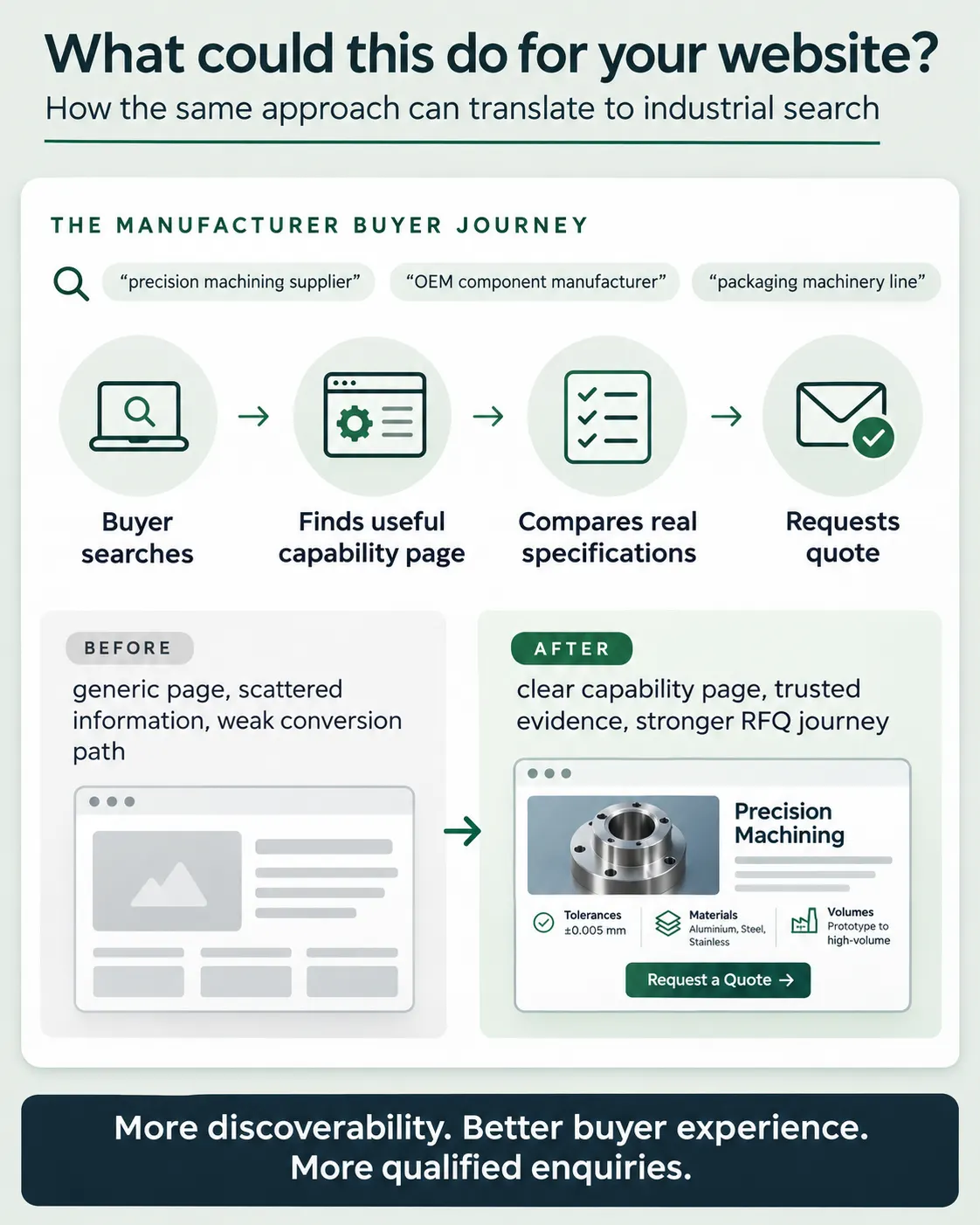
From a search to a better quotation request
“Case packing machine for flexible pouches”
A buyer needs to establish whether a machine is suitable for their application.
One useful product-family page
Approved compatible formats, throughput, integration questions and a selection worksheet.
A better scoped RFQ
Ask for packaging format, target output, site constraints and timescale before a quote.
Illustrative search and proposed improvements, not measured industrial demand or a promised ranking, enquiry or engineering capability.
The same prioritisation method could start with your existing search data and product economics. A lower-volume search for a machine your team can profitably supply may be more valuable than a popular search for a product you do not sell. Where the agent needs a specification it cannot verify, it should prepare the improvement for technical approval rather than inventing the answer.
Example 1: A precision engineering business
Rather than publish another article on CNC (computer numerical control) machining, improve the precision engineering capability page. List supported materials and processes using the manufacturer's approved specifications. Explain which drawings are needed, how parts are inspected and which quantities the company can accommodate. Then give buyers a clear route to request a quote.
Example 2: A machinery supplier
Someone buying packaging equipment may need to compare machine speeds, compatible products, installation requirements and running costs. Build a comparison or worksheet using real engineering data. Our industrial product page blueprint explains what a good product page needs, and our catalogue SEO services put that approach into practice.
These are proposed manufacturing improvements, not past manufacturing client results. An AI system can accelerate website development, but your engineers and product owners must approve technical specifications, safety claims, certifications and capacity. It should never invent facts to capture a promising search term.
START WITH ONE PRODUCT FAMILY
Explore the manufacturing SEO audit ↗See what your buyers are already looking for.
Identify commercially useful search terms, missing product information and improvements worth testing.
05 / THE BUSINESS CASE
Connecting search visibility to qualified sales opportunities
Search visibility is the start of the commercial journey. Our next objective is to establish how the improvements translate into genuine enquiries. We reviewed website notifications from 20 October to 24 November and found five distinct calculator-access submissions, four from business email domains. Some arrived before the AI system began. We excluded duplicate notifications, supplier pitches and internal tests. We have not yet confirmed which of these contacts came from organic search or whether any turned into a won contract.
For a manufacturer, the business case is built in stages. A search appearance is not a website visit. A visit is not an enquiry. An enquiry only becomes a qualified RFQ when it matches the company's capabilities and sales criteria.
- Someone finds a relevant page in an unpaid search result.
- They visit the site and submit an enquiry.
- Sales confirms that the project is suitable and accepts the RFQ.
- The company issues a quote.
- The buyer places an order, producing revenue and gross contribution.
Use the RFQ value calculator to explore how many additional suitable enquiries would make an SEO programme financially worthwhile, using your own conversion rates and profit assumptions. Our guide to measuring organic RFQ quality explains how to track these stages.
What we plan to measure next
Are the improved rankings holding? Has Google revisited updated pages?
Are more relevant terms staying in the top three and ten? How do changed pages compare?
Are more relevant visitors and enquiries coming through?
Have suitable opportunities become quotes or orders? How does contribution compare with cost?
These are measurement targets, not forecasts. Future results can be compared with the original research without changing the definition of success.
06 / HOW WE MEASURED THE EXPERIMENT
Research methods, sources and limitations
For readers who want to scrutinise the numbers, here is how we made the comparisons.
The dedicated hourly system started on 17 November 2026 at 10:45 UTC. The two six-day windows contain 1,985 and 1,931 exact reported search terms respectively. We used final Google Search Console data from the eventmanagementcompany.uk domain property, for web search across all reported countries and devices. The launch-day window includes the hours before the system started. Rankings are impression-weighted averages from Search Console rather than fixed daily positions measured by a rank tracker.
We matched exact query strings across the periods. A top-ten entry was a search term with a later average position of ten or better that had previously ranked worse than ten or was not in the earlier export. The top-three definition uses three instead of ten. Exits include terms missing from the later export. Net change equals entries minus exits.
To identify buying-related queries, we required both a sector word (for example event, exhibition, conference, corporate, festival, trade show, activation, roadshow, stand, webinar or experiential) and a service-intent word (for example agency, company, organiser, planner, management, service, hire, production, supplier or quote). We excluded obvious career, job, training, software and definition terms. This repeatable word-based filter is an estimate of commercial intent; we did not independently confirm the intent of every searcher. We used actual impressions, not estimated monthly search volumes.
Google withholds some search terms for privacy. The individual examples have small impression counts, the observation period is short and Google may not have revisited some edited pages. Other SEO activity was ongoing. Page-level impression counts are not additive to domain-level impressions. To investigate cause and effect, we would compare similarly performing changed and unchanged pages over a longer period and follow the same fixed group of priority search terms.
Sources
- Pearl Lemon's connected Google Search Console property for eventmanagementcompany.uk; final query and page reports retrieved 24 November 2026. The selected CSV is public; complete source exports are internal.
- The original Event Management hourly platform builder planning runbook (17 November 2026) and private repository activity log (17–24 November). These provide the initial 28-day baseline, proposed task scoring model, implementation dates and inspection sample. The 144 live improvement receipts (101 content edits, 43 code releases) are the original preliminary classification. A separate review on 24 November identified 25 live-release records explicitly reporting no additional code CI/build work or that it was not applicable; this is a text-based classification, not a complete cost audit. The webinar example uses the timestamped activity record for that day.
- Deduplicated website form-notification review, 20 October–24 November 2026. No personal contact details are published.
- Google: understanding impressions, position and clicks and AI features in search.
- OpenAI: search crawler documentation.
Frequently asked questions
What is autonomous or agentic SEO?
It is the use of an AI agent to carry out a sequence of SEO tasks, such as identifying opportunities, making changes, checking its work and measuring results. Unlike an AI writing tool, the agent can work through an entire improvement process under defined safeguards.
Does this mean AI can get my company onto page one?
The experiment recorded individual search terms moving into the top ten. It does not show that every company can achieve those rankings, that the changes caused the movements or that the results will persist. A company's starting position, competition, website quality and real capabilities all matter.
Is using AI for SEO the same as ranking in ChatGPT?
No. We used AI to improve a website and measured its visibility in Google web search. Appearing in AI-generated answers is a separate goal. Clear, accessible technical information and useful resources may help discovery, but no system guarantees citations. See our AI search visibility service for manufacturers.
Can a manufacturer automate technical content without engineering review?
Research and routine website improvements can be automated. Product specifications, safety and compliance claims must come from approved technical sources and remain subject to the manufacturer's review.
Where should we start?
Choose one profitable product family or service, find out what prospective buyers search for, improve the information that helps them choose a supplier and test the quote request process. Measure whether relevant rankings and suitable enquiries change.
Research edition: 24 November 2026. Initial findings from the events-sector experiment, with practical manufacturing adaptations. No manufacturing ranking or revenue outcome is claimed.
Explore all industrial SEO resources → · Manufacturing SEO services →
THE NEXT PRACTICAL STEP
Could your best product pages work harder for your sales team?
Tell us which industrial capabilities you want buyers to find. We can discuss a practical first scope, the evidence needed and how to measure the economics of continuous improvement.
No fabricated rankings or guaranteed lead claims. Just a commercial discussion grounded in your actual capabilities.